
Solving the Energy Crisis | eyc-tech Optimizing Air Conditioning Systems to Enhance Data Center Efficiency
- Index
- Solutions
- Industries
- Solving the Energy Crisis | eyc-tech Optimizing Air Conditioning Systems to Enhance Data Center Efficiency

Solving the Energy Crisis | eyc-tech Optimizing Air Conditioning Systems to Enhance Data Center Efficiency
Introduction
The global digitization trend has driven the usage of cloud computing and big data, from virtual currencies to the applications of AI. As a result, the demand for data centers has also increased, leading to a corresponding rise in the energy consumption of their equipment. Apart from the high energy consumption of processors, the power consumption of air conditioning systems responsible for cooling has been increasing year by year, comprising a significant 40% of the overall energy consumption. Therefore, effectively controlling the efficiency of air conditioning systems is particularly important. Optimizing air conditioning systems has always been a significant future energy-saving goal, as it not only reduces energy wastage but also lowers operational costs, facilitating sustainable development.
Utilizing Transmitters to Optimize Air Conditioning System Efficiency
Servers in data centers generate a significant amount of heat during operation, with processors and other electronic components producing substantial thermal energy. To avoid equipment damage caused by high temperatures, server cooling relies on air conditioning systems to provide effective ventilation and cooling. Through transmitters, precise monitoring of air conditioning systems can be achieved, effectively controlling their data.
Facing the energy crisis and sustainability challenges, eyc-tech's range of temperature, humidity, airflow, and differential pressure transmitters, combined with central control systems, adjusts air conditioning systems in response to fluctuations in server workload, ensuring optimal cooling and energy efficiency.
Transmitter Functions in Data Centers
According to the ASHRAE Thermal Guidelines for Data Processing Environments, it is recommended to maintain a temperature range of 18-27°C and humidity below 60% in data center environments.
- Temperature Transmitters
To effectively control environmental temperatures within the 18-27°C range, avoiding overheating and loss of operational efficiency in servers, temperature transmitters installed at key locations such as racks and hot/cold aisles ensure comprehensive monitoring. This enables real-time monitoring of temperature variations and adjustment of air conditioning system operation based on monitoring results.
- Humidity Transmitters
When humidity levels exceed 60%, condensation may occur in air ducts, leading to short circuits or corrosion when condensed water droplets come into contact with electronic components. Conversely, low humidity may cause component brittleness and static electricity damage within servers.
| 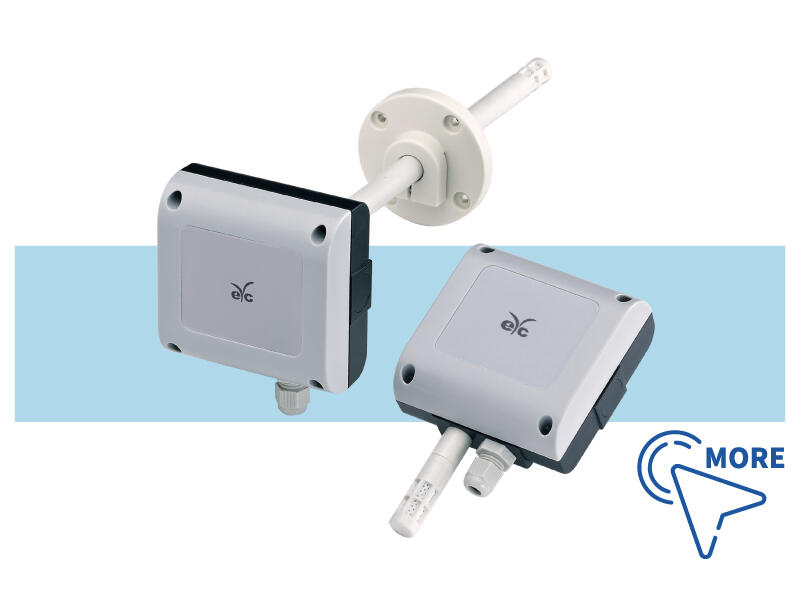 | | |
| eyc-tech THM801 Temperature & Humidity Transmitter Input:Capacitive humidity sensor Output:4 ... 20 mA / 0 ... 10 V / RS-485 Accuracy:±0.15°C / ±1.2%RH Range:-40 ... +80°C / 0 ... 100%RH | eyc-tech THS130/140 Temperature & Humidity Transmitter Input:MEMS Output:4 ... 20 mA / 0 ... 10 V Accuracy:±0.5°C / ±3%RH Range:0 ... 50°C / 0 ... 100%RH | eyc-tech THR23 Temperature & Humidity Transmitter Input:MEMS Output:0 ... 10 V / 4 ... 20 mA / RS-485 Accuracy:±0.5°C / ±5%RH Range:0...50°C / 0...100%RH | eyc-tech THS17 Temperature & Humidity Transmitter Input:MEMS Output: RS-485 / 4...20 mA / 0...10 V Accuracy : ±0.5°C / ±5%RH Range : 0 ... 50°C / 0 ... 100%RH |
- Air Velocity Transmitters
Today, most cooling systems use air-cooling methods for heat dissipation. To confirm effective air distribution to each server, ensuring comprehensive control of temperature throughout the data center environment. Also, by measuring air velocity, efficient removal of hot air emitted from server racks can be assured.
| 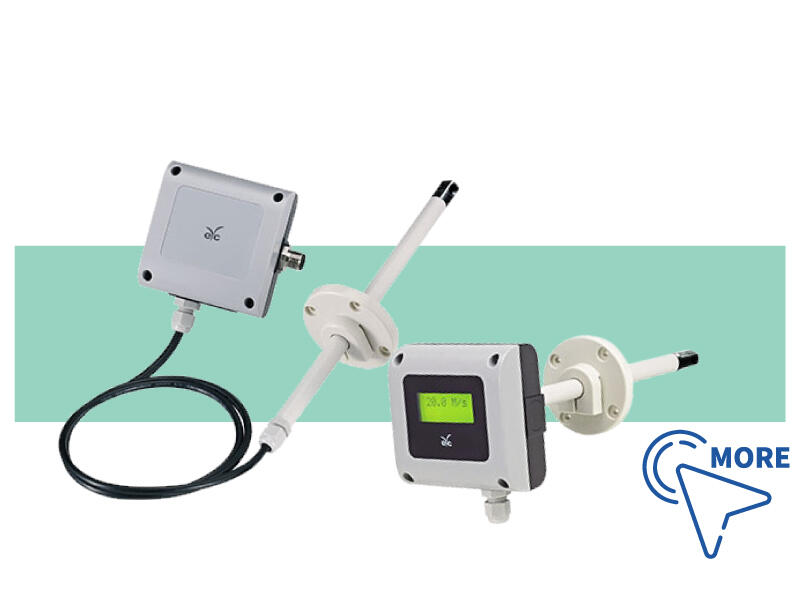 |
| eyc-tech FTS140 Hot Wire Air Velocity Transmitter Input:Hot wire mass flow transmitter Output:4 ... 20 mA / 0 ... 10 V Accuracy:±3%F.S. Range:0 ... 20 m/s | eyc-tech FTS34/35 Air Velocity Transmitter Input:Thermal mass flow sensor Output:4 ... 20 mA / 0 ... 10 V Accuracy:±1% F.S. Range:0 ... 40 m/s |
- Differential Pressure Transmitters
Airflow can easily lead to dust entering servers. Accumulated dust on heat sinks, fans, and other cooling equipment impedes airflow, reducing cooling efficiency and causing equipment overheating and circuit failure. Therefore, by utilizing differential pressure principles, checking filter efficiency, and ensuring positive pressure within the data center, dust entry into servers can be prevented.
| |
| eyc-tech PMD330 Differential Pressure Transmitter (Indoor) Measuring element : Piezoresistive diff. pressure sensor, no flow-through Measuring range:±50 ... ±10000 pa Output : 4 ... 20 mA / 0 ... 10 V / RS-485 Accuracy : ±2.0% F.S. IP rating : IP65 | eyc-tech PMM330 Differential Pressure Transmitter (Indoor) Measuring element : Hot-wire type diff. pressure sensor, flow-through Measuring range : ±50 ... ±1500 Pa Output : 4 ... 20 mA / 0 ... 10 V / RS-485 Accuracy : ±1.5% F.S. ±3% M.V. IP rating : IP65 |
By installing various transmitters in data centers and real-time control of all environmental data, data center efficiency and safety can be improved, providing users with safe and effortlessly creating green data centers.