
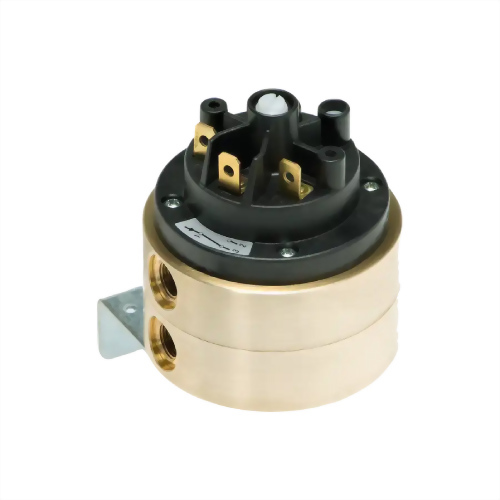
Features
The differential pressure switches of Type 630 are suitable for flow monitoring in sanitary and heating systems or for level control in general process engineering. The extremely robust design allows for a system pressure and a one-sided overload of up to 20 bar.
• High overpressure safety on both connections (P1, P2) up to 10/20 bar
• Functionally simple and robust mechanics with high operational reliability
• Also suitable for slightly aggressive liquids and gases
• Reproducibility up to < ±0.4 mbar
• High overpressure safety on both connections (P1, P2) up to 10/20 bar
• Functionally simple and robust mechanics with high operational reliability
• Also suitable for slightly aggressive liquids and gases
• Reproducibility up to < ±0.4 mbar
Specification
| Pressure range | |
| Relative / Differential | 6 ... 5500 mbar |
| Operating conditions | |
| Medium | Liquids and neutral gases |
| Medium temperature |
NBR 0 ... +80°C FPM -10 ... +80°C EPDM -10 ... +80°C Silicone -40 ... +80°C |
| Ambient temperature | +65°C |
| Storage temperature | -40 ... +80°C |
| Tolerable overload (P1 > P2) |
< 200 mbar: 10 bar > 200 mbar: 20 bar |
| Rupture pressure | 30 bar |
| Lowest turn-on pressure | > 6 mbar |
| Smallest switching difference | > 3 mbar |
| Materials in contact with medium | |
| Diaphragm | NBR / EPDM / FPM / Silicone |
| Pressure case | Anodized aluminium / Brass / Nickel plated brass |
| Other components |
X14CrMoS17 (1.4104) X5CrNi18-10 (1.4301) X10CrNi18-8 (1.4310) Steel A2 screws Polyacetate-C / Polyamide |
| Electrical overview | |
| Nominal voltage | 250 VAC |
| Nominal current (resistive) | 1 A |
| Nominal current (motor) | 0.5 A |
| Contact system | Changeover contact |
| Mechanical life | 10⁶ switching cycles |
| Protection | |
| Without cover | IP00 |
| With cover (PG11) | IP54 |
| With cover (PG9) | IP65 |
| Repeatability | |
| NBR / Silicone | ±5% of switching point (min ±0.4 mbar) |
| FPM / EPDM | ±10% of switching point (min ±0.8 mbar) |
| Electrical connections | |
| Screw terminals | Option |
| Tab connectors | AMP 6.3 mm |
| Cable gland | PG9 / PG11 |
| Pressure connections | |
| Thread | G⅛ |
| Straight screwed connection | Ø 6 mm (G⅛) |
| Screwed socket | Ø 6 mm (G⅛) |
| Weight | |
| Aluminium base | ~ 380 g |
| Brass / Nickel plated brass | ~ 1000 g |
Download
Note : Design and specifications are subject to change without notice.
Note : Please make sure the product and the device which connect with RS-485 are on common ground, avoid damaged product.